

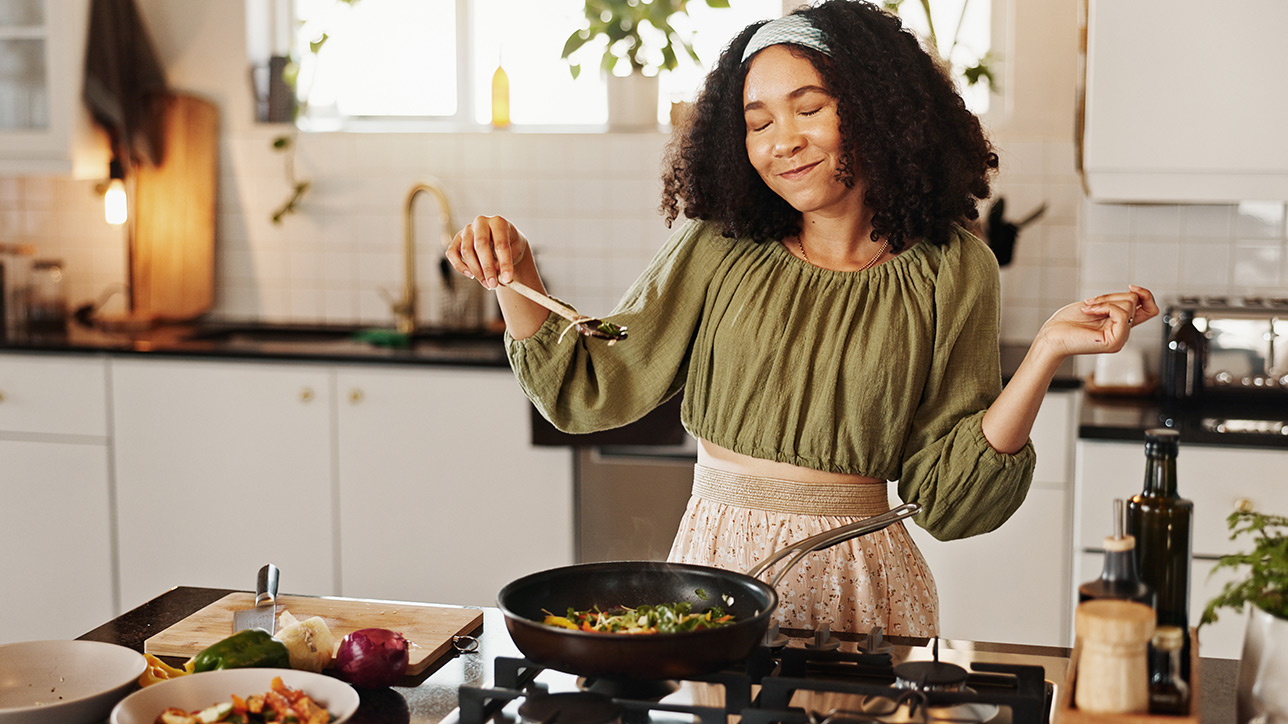
You don’t have to be “an artist” to make art. If you squint at it a bit (allowing your understanding of the world to expand and shift) you might discover you’re already doing it.
Consider a few examples: homemaking, seasonal decorating, dancing, singing in church or at karaoke, telling a joke, arranging a plate for a fancy dinner (or even an everyday lunch for your child), or simply the way you walk down the street or move through grocery aisles with a little extra fun, grace, or efficiency.
When approaching the produce section, my father—a usually somewhat formidable figure—would burst into his rendition of “This is the Dawning of the Age of Asparagus,” complete with dance moves. I admit I was somewhat mortified in middle school, and yet it remains one of my fondest memories. It reminds me that we can make inventive connections with words and references, not take ourselves too seriously, and invite some fun into the everyday.
At its core, making art can mean allowing yourself expression, creating meaning, and being understood. Research shows that creative expression can support emotional wellbeing, reduce stress, and help people make sense of their experience.1 Additionally, making art can help you process experiences in ways words alone sometimes can’t—and it can happen at home, in community spaces, or alongside therapy.
1. Reduce Stress, Anxiety, and Low Mood
Studies consistently show that participating in creative and artistic activities is linked to lower levels of stress, anxiety, and depression, as well as improved overall wellbeing.1 Terms like, “sing your heart out” or “leave it all out on the dance floor” belie the feeling of stress reduction and exhilaration creative expression can provide. Creative activities can help calm the nervous system, reduce stress hormones, and shift attention away from constant worry or rumination. Even short periods of creative engagement can help people feel more grounded and regulated.
2. Express Feelings That Are Hard to Put Into Words
Some emotions don’t come easily into language, especially feelings connected to trauma, grief, or early experiences. Art allows you to express emotions without needing to explain them or necessarily put them into words. Giving feelings a form (an image, a movement, a song, or a story) can allow insight and a sense of being understood, seen, heard. Often, creative practices don’t only involve thinking. They involve the body and senses. Movement, music, and visual expression activate parts of the brain connected to emotion, memory, and physical regulation. Research shows that activities like dance and music can support emotional regulation, cognitive functioning, and overall wellbeing, especially when stress or trauma is stored in the body.2
3. Make Your Experiences Concrete: Art as a Way to “Hold” What Matters
One of the most powerful aspects of making art is that it turns experiences into something tangible. Big moments (for example: losses, transitions, insights, or personal growth) can feel abstract or fleeting. Creating something that holds the whole of the experience including nuance and ambiguity, helps make them real and lasting. In this way, art can act like a memorial: This mattered. This happened. This is part of my story. Also, things like writing about an experience, creating an image, or embodying it through movement can help the brain organize and integrate what you’ve lived through. Art can become something you return to: a reminder of your strength, your grief, your growth, or your values.
Examples of Memorializing Through Art
- Writing a letter or poem to mark a loss or ending
- Creating a drawing or collage that represents a life transition
- Moving or dancing to a song with meaning for you at a certain time
- Singing or listening to music connected to a meaningful chapter of your life
4. Make Meaning
When company was coming, my grandmother always made biscuits. And she made a practice of saying/singing prayers for each person who would eat the biscuits, as she rolled out the dough, cut it into rounds, and laid them in the cooking pan. You don’t have to be religious to practice this kind of art. Through giving voice to her care and hope for her guests, my grandmother made meaning of her biscuit-making task. Similarly, I had a friend in high school whose mother would always put little notes in her bagged lunch featuring drawings and jokes and well wishes. This gave her mother a tangible way to express her care and my friend kept these notes into adulthood, as concrete reminders of her mother’s love. All day we see things and move our bodies and use our voices. Many of us might write or make things. Allowing yourself to attach meaning to these things can be healing and sustaining.
1World Health Organization. (2019). What is the evidence on the role of the arts in improving health and well-being? A scoping review. WHO Regional Office for Europe. https://www.who.int/europe/publications/i/item/9789289054553
2Koch, S. C., Riege, R. F. F., Tisborn, K., Biondo, J., Martin, L., & Beelmann, A. (2019). Effects of dance movement therapy and dance on health-related psychological outcomes: A meta-analysis. The Arts in Psychotherapy, 63, 101–114. https://doi.org/10.1016/j.aip.2018.12.004
